
Why Your Business Stops Growing at 3, 10, and 30 Million: The Rule of 3 and 10
When a mid-market company hits a sudden growth plateau, understanding the rule of 3 and 10 can explain why growth stops compounding… And why the harder leadership pushes, the flatter it gets.
This frustrating stagnation is not the result of bad luck or a sudden lack of hustle from your team. Instead, it’s a predictable, structural pattern that repeats at specific revenue and scale levels in almost every industry.
If you feel like your business has hit a wall despite doing everything that used to work, you aren't failing. You’re just experiencing a natural evolution in the corporate lifecycle.
What Is the Rule of 3 and 10?
The Rule of 3 and 10 is a structural framework stating that every time a business triples in size, everything inside the organization fundamentally breaks and must be reinvented.
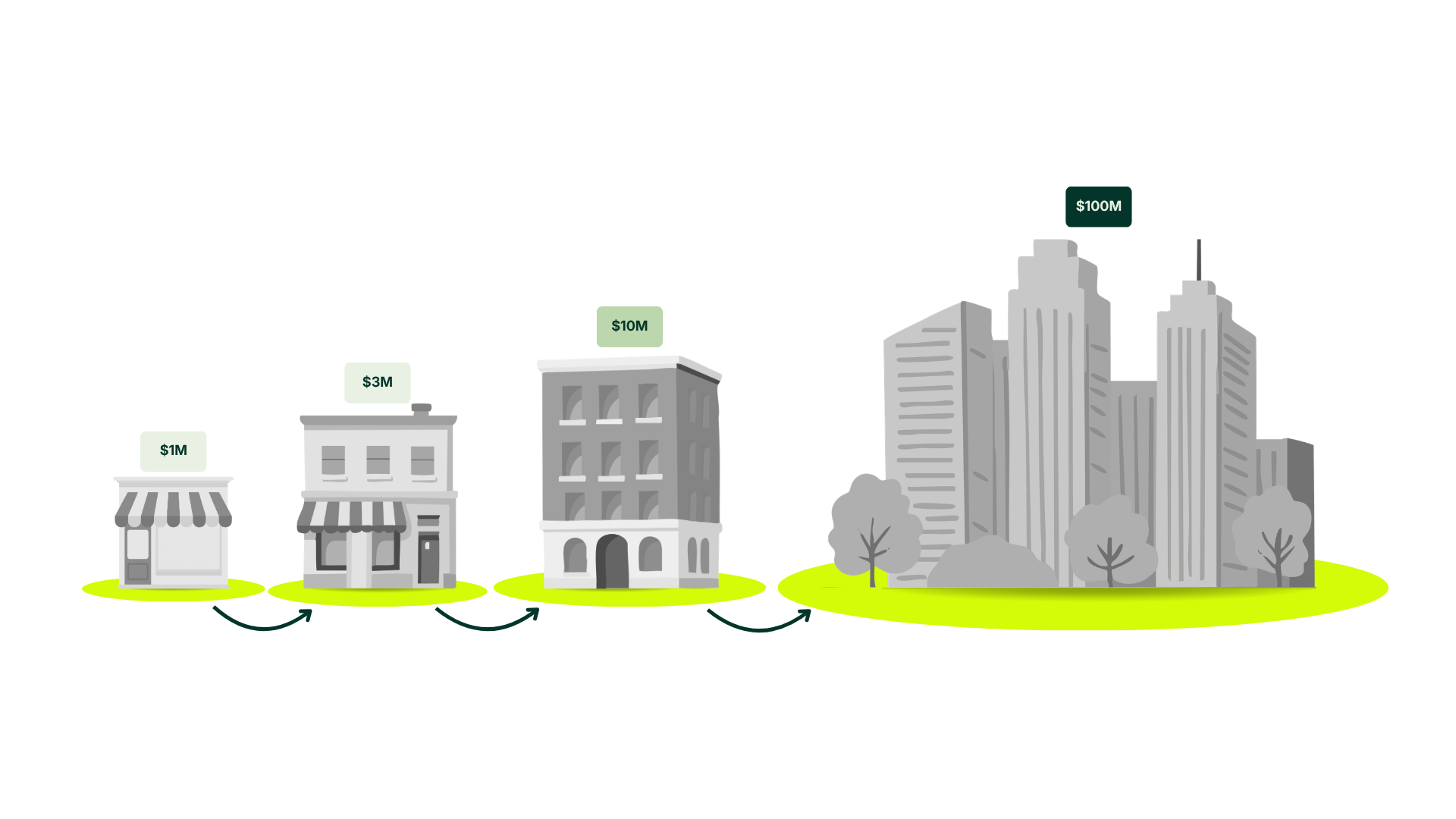
When an organization expands by orders of magnitude (roughly at thresholds of 3, 10, 30, and 100) its existing workflows, communication channels, and governance structures are pushed past their operational limits. If leadership fails to proactively build systems designed for the next level of scale, the business inevitably hits a plateau.
This term was originally coined by Hiroshi Mikitani, the visionary CEO of Rakuten, and later popularised by author Tim Ferriss, this concept has historically been applied primarily to employee headcount. However, at CoStrategy, we apply this diagnostic tool much more broadly because we’ve seen the Rule of 3 and 10 across various factors time and time again.
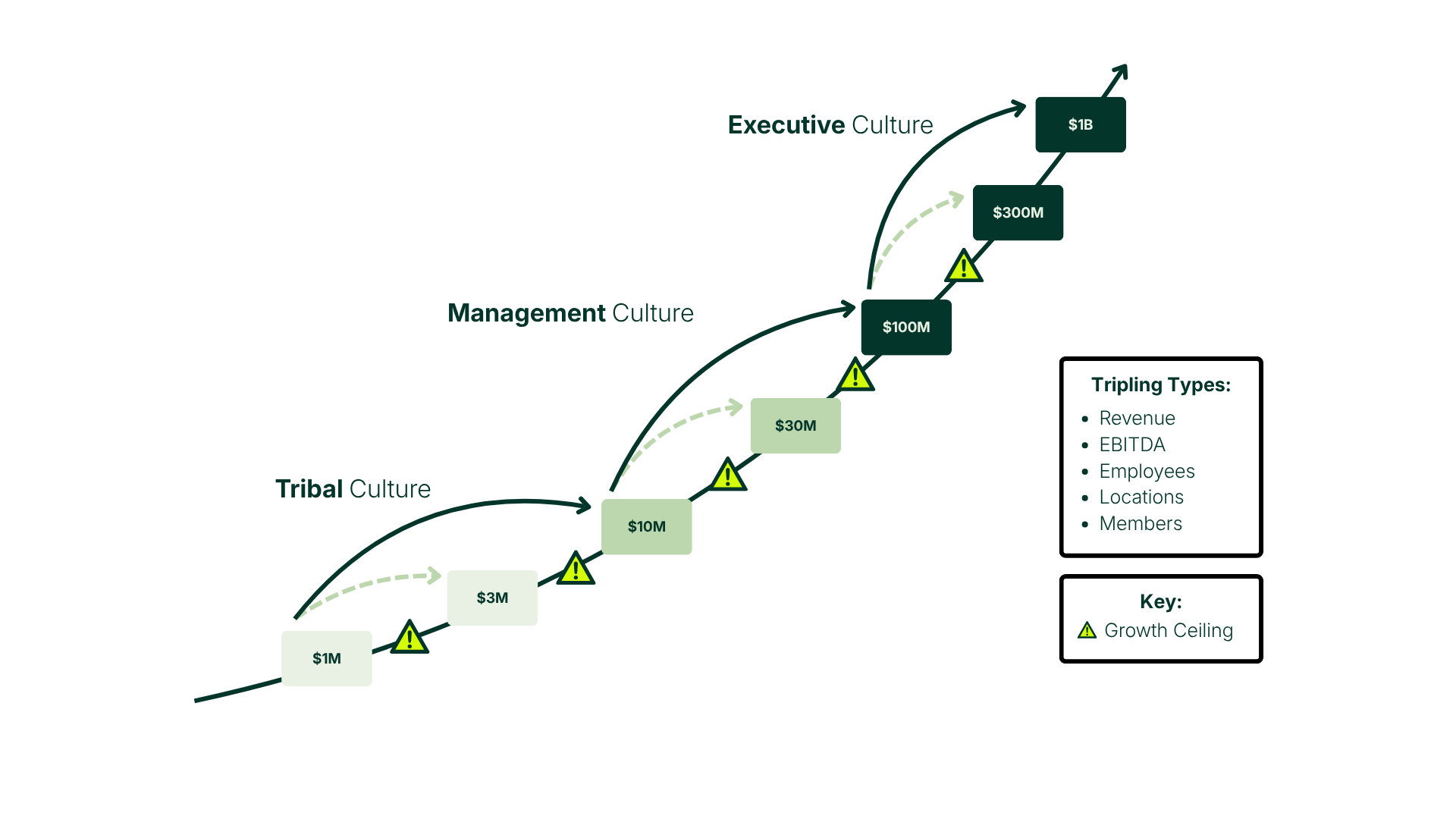
A Growth Ceiling business isn't just suffering from a crowded organizational chart. The 3x rule impacts:
Your revenue,
Your EBITDA,
Your operational locations,
And your client concentration.
When any of these core operational metrics triple, the infrastructure that successfully managed the previous phase becomes the exact bottleneck holding the business back.
Recognizing this pattern as a structural signal rather than a personal failure is the first step toward evolution.
The Three Leadership Cultures (And Why They Break)
As a business scales through these macro-thresholds, it must transition through three distinct operational eras, each requiring a fundamentally different style of leadership.
When an organization ignores these cultural shifts, it triggers the exact conditions that explain why businesses stop growing.
Tribal (Owner-Operated) Culture ($0 to $10 Million): In the early stages, everything flows directly through the founder. A few loyal lieutenants may pull the operational strings, but the owner is the system. Decisions are fast, relationships are personal, and growth is driven by sheer entrepreneurial will.
Management Culture ($10 Million to $100 Million): As revenue crosses the $10M mark, the owner-centric model shatters. The business desperately needs a professionalized leadership team. That leadership team includes a president, and dedicated heads of revenue, finance, and operations. The founder must let go of daily micromanagement and transition into a true strategic leader.
Executive Culture ($100 Million+): At this tier, the transitions that previously occurred at the company level repeat within individual departments. Your original lieutenants must now act like small business owners themselves, requiring a robust layer of middle management to coordinate execution.
Each of these shifts are painful because it often feels like throwing the baby out with the bathwater. The very habits, instincts, and close-knit dynamics that made the business successful in the previous stage must be systematically abandoned to make room for the structures required by the next.
The Two-Step Pattern Inside Every Transition
Navigating these shifts involves managing a predictable, repeating two-step operational cycle:
FIRST: People
SECOND: Systems
When a business aims for a new growth tier, the initial reaction is to pull in more bodies to handle the increased workload and reach the next level. This influx of talent provides the temporary capacity needed to scale up. However, many operators make the critical mistake of pausing there.
To permanently hold that ground, leadership must follow up by building the formal systems, documentation, and repeatable processes required to support the larger team.
A business that skips the systems step will repeatedly bounce back down from its ceiling. Without a structured foundation, the organization cannot sustain the weight of its own expansion, leading to a perpetual cycle of backsliding.
What a Growth Ceiling Actually Feels Like
Hitting a Growth Ceiling is rarely a silent event. It presents itself through visceral, exhausting organizational symptoms:
Instead of a healthy, predictable business, operators begin to notice shrinking margins and rapidly rising overhead costs. This is the margin squeeze: where you find yourself working twice as hard for a fraction of the return.
You’ll notice an effort gap: sales performance becomes wildly inconsistent, and growth remains completely flat despite a major influx of marketing spend, headcount, and hours logged.
Instead of winning deals through a repeatable, scalable market strategy, the company relies heavily on opportunistic sales: revenue driven almost exclusively by the founder's personal relationships, luck, and unpredictable word-of-mouth referrals.
When these indicators appear, it’s an undeniable sign that your business growth plateaus because you have reached the operational limits of your current business design.
The Most Dangerous Response to a Growth Ceiling
When growth stalls, the default entrepreneurial instinct is to double down on what worked before: demand more.
Leaders push for more sales calls, more marketing spend, more headcount, and more overall activity.
The drive for more is the single most dangerous response to a growth bottleneck.
Flooding a stuck system with more only accelerates your spend in the wrong direction and burns out your best talent. Businesses get stuck not because they’re working too little, but because they’re working harder at the wrong things.
More is the strategy of your previous revenue level.
To break through, you must shift your focus from raw activity to strategic alignment. Before you can successfully build out operational capacity, you must clarify your market positioning and establish a crystal-clear competitive positioning strategy. You need to explicitly define where you play and exactly how you win.
Frequently Asked Questions
What is the Rule of 3 and 10?
The Rule of 3 and 10 is an organizational framework stating that a business fundamentally changes and breaks every time it triples in size. As metrics like revenue, headcount, or locations scale by orders of magnitude, the existing operational structures must be completely redesigned to prevent growth from plateauing.
Why do businesses stop growing at $10 million?
Businesses typically stall at $10 million because they hit the absolute limit of the owner-operated model. To scale past this point, an organization must transition into a formalized management culture, which requires the founder to delegate control to a professional leadership team and replace ad-hoc habits with repeatable systems.
What is a Growth Ceiling?
A Growth Ceiling is the operational threshold at which a company has outgrown its structural capability to expand using its current systems, leadership models, and market positioning. It manifests as flat revenue, declining margins, and a widening gap between team effort and actual business results.
How does CoStrategy use the Rule of 3 and 10?
CoStrategy uses this framework as our foundational diagnostic model to pinpoint exactly where an organization's infrastructure is breaking down. By mapping a business against these predictable thresholds, we build a customized strategic roadmap that helps operators transition smoothly between leadership cultures. This targeted approach bridges businesses directly into our growth programme to unlock sustainable capacity.
Evolve Your Structure
Most businesses default to pushing harder when growth stalls, assuming that more effort, more spend, and more noise will blast through the wall. But the rule of 3 and 10 proves that the true bottleneck is never a lack of effort, it’s a limitation of structure.
You have simply outgrown the exact operational model that got you to this point, and pushing it harder will only cause it to break further.
CoStrategy is built to diagnose exactly where you are in this lifecycle and build the sharp positioning and scalable capacity you need to safely ascend to the next tier of growth.